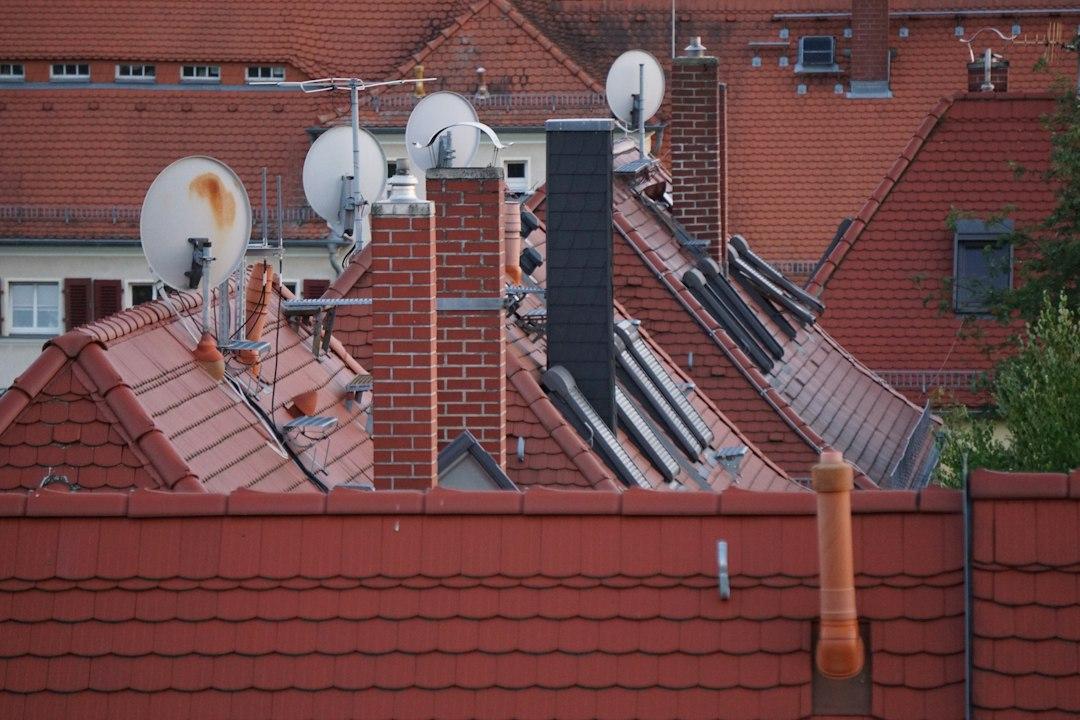
Gas fires start at the top of the chimney
A new log set is an indoor purchase. You pick the logs, the burner and the ember material in a showroom, and the change you notice happens in the living room. But a vented log set depends on the chimney above it, and in Laguna Hills the part we most often have to fix first is the very top: the concrete slab around the flue and the cap over it.
Calvert Chimney Services checks both before fitting any gas log set. This post explains why, what the common faults look like, and what it costs to put them right before the logs go in.
Why the top matters more with gas
With wood, a small leak at the top of the chimney often went unnoticed. The fire dried out the flue every time it burned. Gas fires run cooler, and the exhaust carries water vapor. Add rain coming down through a cracked crown or an open flue, and the inside of the chimney stays damp for weeks. That damp eats the mortar joints, flakes the tile and rusts the burner pan sitting in the firebox below.
A log set also keeps the damper clamped open for good. That means whatever falls down the flue lands on the logs: leaves from the eucalyptus and pepper trees common around Laguna Hills, nesting from birds, and rain. A sound top keeps all of that out.
What we find on the crown
The crown is the concrete or mortar slab at the top of a masonry chimney. It sits around the flue tile and should be thick enough and shaped to throw rain off the stack. On many older houses here, it was never built that way. Common faults:
- hairline cracks that let water into the brick below
- a crown that is flat or dished, so water sits on it
- a crown with no gap around the flue tile, which cracks as the tile heats and cools
- pieces broken loose, often after one of the bigger shakes of past decades
Small cracks can be sealed. A crown that has split through, or one that was never more than a skim of mortar, is better broken off and cast again. Chimney crown repair explains how we approach each.
What we find at the cap
Many Laguna Hills chimneys have no cap at all, or a thin galvanized one that has rusted through near the coast, where salt air reaches up the canyons from Laguna Beach and Dana Point. A good cap has a solid top, a mesh around the sides to keep out birds and embers, and a size that fits the flue it covers.
If the gas conversion includes an insert, the cap is often replaced with the termination that comes with the vent kit. If it is a log set, the existing flue stays open, and a proper cap is part of the job.
What sets the price
Every cap Calvert installs is quoted on site. The simplest job is a standard stainless cap on a single flue. The biggest job is custom caps over wide crowns with several flues, or copper work to match a house.
The crown has no fixed figure on our list. Sealing a few cracks is a short job. Recasting a crown on a tall two-flue chimney on a steep roof is a much bigger one. We look at it, then give you a written figure with the cap and the logs on the same page so you see the whole conversion at once.
If water has already reached the inside of the house, a leak repair runs $595 to $3,550, and we usually trace it as part of the same visit. Our page on chimney leak repair covers that work.
Get the top priced with the logs
Give us the age of the house and whether you can see a cap from the street, using the form. We will look at the crown and cap on the measuring visit and quote them with the log set.
The inspection behind the quote
Before any gas goes into an old flue, we want to see inside it. A Level 2 inspection at $415 runs a camera from the firebox to the top and records the crown, the cap and the tile. If the camera shows the tile is cracked, a liner may have to come before the logs, which our post on liners for a gas conversion covers.
If a sweep has not been done since the last wood fire, we start with that, from $445. Gas logs should not sit under a flue still coated in old soot.
What else to fix while the roof is open
The work at the top often brings up the flashing, the metal that seals the roof to the brick. If it has lifted or rusted, it is easy to replace while we are up there. On a wide chimney on a sloped roof, a cricket, a small ridge that sends water around the stack, can stop water pooling behind it. On its own, that ridge is $475 to $1,075; paired with fresh metal on every side of the stack it comes to $715 to $1,750.
Doing these jobs together is cheaper than coming back later, and it means the new log set starts in a dry chimney.
If you are still deciding
If you have not settled on logs, compare the options in gas logs, insert or sealed unit. The crown and cap matter for a log set and for an insert, but much less for a sealed unit in a new wall that bypasses the chimney.
When you are ready to have the top of your chimney looked at with the conversion in mind, reach Calvert through the contact page.
Want Figures for Your Own Fireplace?
Calvert Chimney Services measures the opening, checks the flue and writes up each gas option with its own price. Work covers Laguna Hills and the cities on our areas page, and nothing starts until you have read the quote.