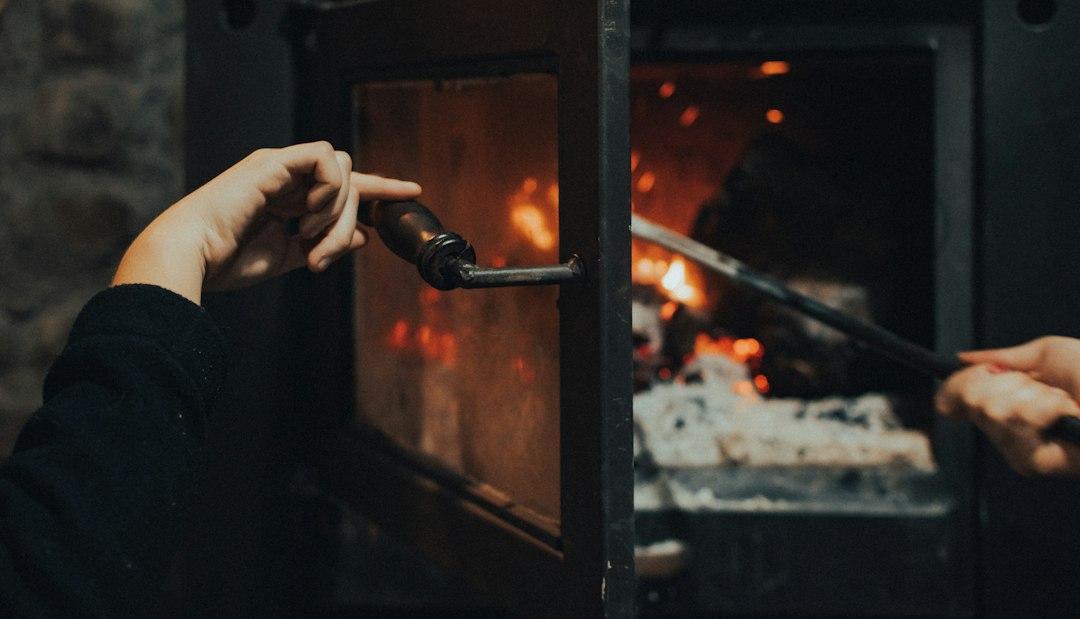
You are done hauling wood. Now what?
Most owners who call us in Laguna Hills about going gas have already decided the wood part. They are tired of ash on the rug, smoke on no-burn days and a firebox that heats the chimney more than the room. What they have not decided is which kind of gas fire to buy. There are three choices we fit, and they differ in price, in heat, in what they ask of the chimney and in how the fireplace looks afterward.
Calvert Chimney Services quotes all three, so we have no reason to steer you toward one. Below, each option gets its own section with what it costs where we publish a figure, what the chimney has to provide, and the kind of house it suits.
Option one: a log set on a burner
A log set is a steel burner pan with ceramic logs arranged on top, set into the masonry firebox you already have. The fire looks the most like wood of the three. The glass doors stay open or come off, the damper is clamped so it cannot shut, and the exhaust rises up the old flue just as smoke did.
This is the lightest change to the house and the least costly of the three. The price depends on the size of the burner and the style of logs, and whether a gas line already reaches the firebox. Most of the money goes into the logs themselves, because realistic ceramic sets cost more than plain ones.
The trade is heat. With the damper fixed open, much of the warmth goes up the chimney. A log set is for looks and a bit of warmth near the hearth, not for heating the room. It also needs a flue in good shape, since that flue still carries exhaust. Every set we fit is a vented set. Our gas logs service page covers the burner and log choices.
Option two: a sealed insert
An insert is a closed box with a glass front that slides into the masonry opening. It pulls its air from outside and sends its exhaust up a new vent run inside the old chimney, so the room air stays in the room. With a fan, it heats a living room on its own.
Calvert installs inserts for $2,950 to $5,950. Where a job lands depends on the unit size, the vent length and the gas supply; the full breakdown is in our post on gas insert cost.
What the insert asks of the chimney is a clear path for the vent pipes and a top that will hold a cap. The flue itself no longer carries smoke, which is why an insert is often the answer when the old clay tiles are cracked. The fire looks more contained than a log set: you see it through glass, framed by a steel surround.
This option suits a family room that actually gets used on winter evenings, and a household that wants the fireplace to do some real heating work.
Option three: a sealed unit in a new spot
The third option skips the old chimney entirely. A factory-built gas fireplace with its own sealed vent goes into a wall, and the vent leaves the house through the siding or the roof. It can go where there has never been a fireplace: a bedroom, a patio room, the wall across from the sofa where the TV is.
Calvert prices these between $4,750 and $9,550. The spread comes from the framing needed, how far the vent must travel to an outside wall, and the gas run to the new location.
This choice also fits homes with a worn-out prefab fireplace. Many houses built in Laguna Hills and Mission Viejo during the 1970s and 1980s have a factory-built firebox and a metal flue. When that unit is past repair and no insert is listed for it, a new sealed unit in the same space is often the cleanest answer. A building permit is part of this job; see permits for a wood to gas switch.
Side by side
| Point | Log set | Insert | Sealed unit |
|---|---|---|---|
| Uses the old flue | Yes, as is | Vent runs inside it | No |
| Heats the room | Little | Yes | Yes |
| Look | Open flame | Fire behind glass | Fire behind glass |
| Calvert price | Priced by set | $2,950 to $5,950 | $4,750 to $9,550 |
What the chimney decides for you
Often the house makes the choice before taste does. A cracked flue rules out a log set until it is relined, because the exhaust would leak through the cracks. A crumbling stack top may need work before any vent cap can be fitted. A prefab firebox may accept no insert at all.
That is why we look before we quote. A Level 2 inspection at $415 puts a camera through the full flue and answers those questions in one visit. If the flue is sound, all three options stay open. If it is not, the report says which one still fits and what has to be fixed first, and our post on liners explains that route.
Book the look that settles it
Use the form to tell us which of the three you are leaning toward and what burns in the fireplace today. We book the inspection and the measuring in one trip and send prices for the options your chimney allows.
Running costs and upkeep
All three burn natural gas, so running cost follows how long you leave them on. The sealed options waste less heat up the stack, so an hour of use warms more of the house. Each still needs a yearly look: a log set at the burner and the flue, an insert at the glass, gasket and vent cap, a sealed unit at its vent terminal outside. Our gas fireplace repair team handles pilots, valves and igniters on all three.
A note for sellers
A buyer walking through an older Laguna Hills house sees an open brick firebox as a project. The same room with any of these three gas options reads as finished. If you are thinking of selling within a year or two, the home sale page explains what the buyer's inspection will look for.
When you know which fire you want, or want help choosing, the contact page gets a Calvert technician out to look at what you have.
Want Figures for Your Own Fireplace?
Calvert Chimney Services measures the opening, checks the flue and writes up each gas option with its own price. Work covers Laguna Hills and the cities on our areas page, and nothing starts until you have read the quote.